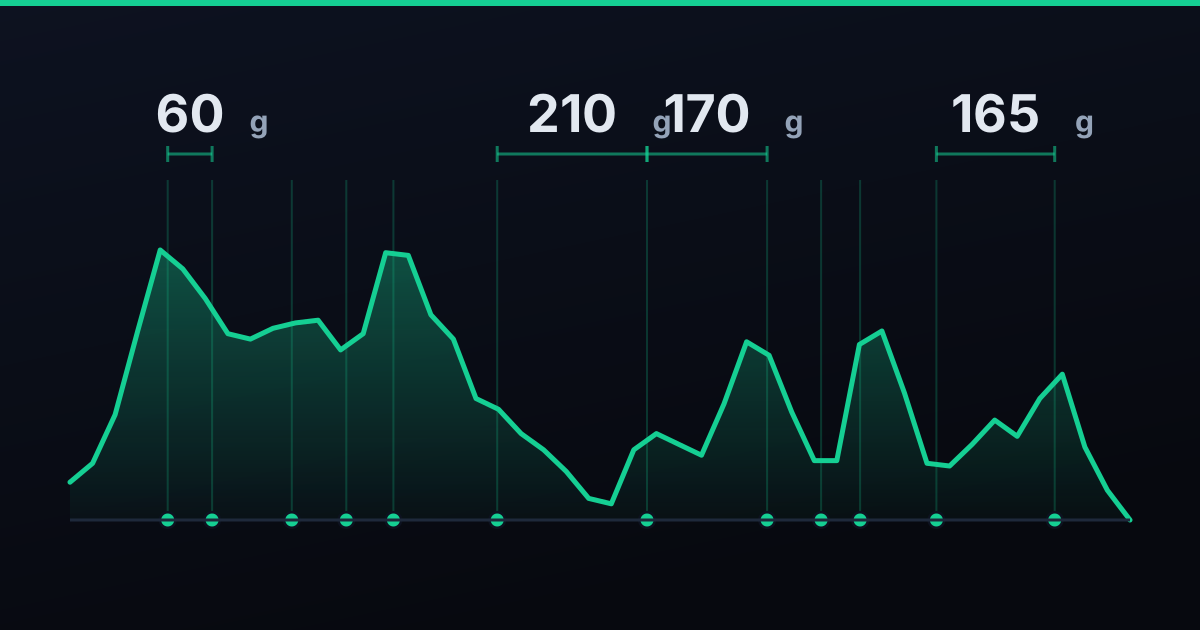
The question a runner asks leaving an aid station is not «how many grams per hour». It is far more concrete: what do I need to carry to reach the next one? For a long time TrackLAB answered the first question. This article explains why we changed, and where the numbers come from.
An hourly split does not fit in a pack
Almost every nutrition calculator gives you an hourly target: 60 g, 80 g, 90 g. That is a fine physiological target and a useless plan. Nobody leaves an aid station thinking «I will eat 80 grams over the next sixty minutes». They think «the next one is three hours away — how much do I take?».
The difference is not stylistic, it is a difference of unit. An hour is a unit of the clock; the leg between two points is a unit of the race. Only the second one maps onto a real decision: what goes in the vest before you zip it up.
Why legs are not worth the same
Here is the detail that changes everything. A 13 km leg costs wildly different things depending on how much it climbs:
| Leg | Distance | Climbing | Time | Carbs |
|---|---|---|---|---|
| Valley link | 13.6 km | +180 m | 1 h 35 | 95–140 g |
| Climb to a col | 13.7 km | +965 m | 3 h 05 | 185–275 g |
Almost the same distance. Twice the food. Splitting by kilometres would claim both legs need the same, and would send someone up a three-hour climb carrying ninety minutes of food. That is why TrackLAB splits by the time of each leg, taken from the pacing plan — the same one that tells you what time you will be there.
Where the grams come from
The hourly target is not our number. The consensus range for efforts beyond 2.5 hours is 60–90 g of carbohydrate per hour, and above 60 g/h you need two sugars (glucose and fructose) because the intestinal glucose transporter saturates. That is the reason almost every sports drink uses that blend.
On that base, TrackLAB adjusts for three things: your weight, how many hours you will be out and the forecast temperature — which mostly moves fluid and sodium rather than carbohydrate.
And why you see a range, not an exact figure
Because the science gives a range. Saying «you need 187 g on this leg» would be inventing a precision that does not exist: gut tolerance is highly individual and trainable. A range tells the truth, and it is more useful too — it leaves you room on the day your stomach disagrees.
Gels and flasks: a translation, not a measurement
«185–275 g of carbohydrate» is correct and cannot be put in a pack. So next to it you will see «≈ 7 gels and 3 flasks». That translation uses a 25 g reference gel and a 500 ml flask, and we say so on the screen itself, because it is our equivalence and not a measurement.
If you carry something specific, add it: under «What you carry» you can register what you actually use with the grams from its label. That figure will always beat any average we could publish — you are the one holding the sachet.
You will also notice TrackLAB names no brands. That is deliberate: an app that plans your race has no business recommending products, and a branded catalogue goes stale every time someone reformulates. Generic categories to start with, and your exact products whenever you want to add them.
What TrackLAB will not tell you
This matters as much as the rest. We do not say what each aid station has. Not whether there will be broth, nor whether the halfway one has fruit, nor whether you can leave a drop bag at the life base.
That is in each race's own rules and we do not have it. The points you see come from the waypoints in the official GPX — their kilometre and their name — or from the ones you mark yourself. What we work out is what you need to get from one to the next, which is a question that can be answered without inventing anything.
The type of point (water, aid, life base) comes from how the waypoint is written in the GPX, and from nothing else.
Three practical things, whatever app you use
- Plan by legs, not by hours. Look at the profile between two points before deciding what to carry. Two legs of the same distance can demand twice as much one as the other.
- Train your gut the way you train your legs. Tolerance at 90 g/h is built; race day is not the day to try it out.
- Count fluid separately. What you carry at the start says nothing about whether you will drink enough: you refill along the way, and you drink by thirst and by heat.
In TrackLAB all of this lives in Race Strategy, under the fuelling tab, and it travels whole into the PDF dossier you take with you on race day: every point with its arrival time, its pace, its temperature and what you leave the previous one carrying.
This article describes how we build an estimate; it is not medical or sports-nutrition advice. Individual needs vary a great deal, and there are conditions — diabetes, digestive disorders, pregnancy — where you should speak to a professional. Hyponatraemia from drinking too much is a real risk in long events: drinking «just in case» is not safer than drinking to thirst.